

Time to Change: A Story of Change, Resilience, Success, and a Reindeer with a Little Red Nose
It’s Christmas Eve and its the final #AdventBlog in the lead up to the big day. However, I am thrilled that we will have more during Christmas and New Year and potentially into 2026!
Today’s blog is a wonderfully written festive one by Debs Barker, who is a Senior HR and L&D professional and the founder of Thinkish — a consultancy focused on inclusive learning, culture change, and leadership development. Find out more at https://www.linkedin.com/in/brains-behaviour-belonging/ Finally, I hope you have an amazing Christmas, and see you on the 26th December with a few more #AdventBlogs. Over to Debs.
Did you know that Rudolph the Red-Nosed Reindeer is a fairly recent addition to our Christmas tradition? Today, he feels as though he has always been there, gliding alongside Dasher, Dancer, Prancer, and the other familiar reindeer from A Visit from St. Nicholas (more commonly known as ’Twas the Night Before Christmas), first published in 1823. But what we recognise now came later.
Rudolph’s story began in early 1939 as a task assigned to Robert L. May, a copywriter at Montgomery Ward, a department store based in Chicago. May was asked to create a Christmas story to be printed and given away to children in stores, with the aim of increasing footfall across the company’s 500+ American locations. The booklet was part of his day job, which largely involved writing catalogue copy, selling everything from jumpers to seasonal suits.
At the time, May was living with his young daughter and caring for his seriously ill wife. Medical debts were mounting, and job security was far from assured.
This was decades before Medicare or the Affordable Care Act, when treatment costs fell entirely on families. Completing the assignment successfully was crucial to keeping his job and demonstrating his value. Under that pressure, true creativity often emerges.
In the evenings, once the house was quiet, May worked through ideas that could turn a simple giveaway booklet into something memorable. He drew on small, ordinary moments from his life, including visits with his daughter to Lincoln Park Zoo, where she was especially fond of the deer.
May knew that whatever he created had to fit within the Christmas traditions people already recognised. His task was not to invent a story from scratch with unlimited time or budget. The character had to feel instantly familiar to children, able to step into a Christmas story they already knew. Santa was already at the centre of those stories, and reindeer were also a huge feature, pulling his sleigh and appearing in tales children loved. A reindeer gave the story a place to begin. And a deer, well, that was one of his daughter’s favourites. A small detail, perhaps, but one that mattered.
May’s own childhood memories of feeling out of place, and the eerily similar experience of his daughter, who was quiet and often overlooked, shaped the premise of this beloved Christmas tale. Stories he already knew, including The Ugly Duckling, about rejection, difference, and eventual acceptance, also guided him. Together, they gave the story its focus.
To show that this little reindeer did not quite belong, May drew attention to his physical features. He turned the reindeer’s big brown nose crimson red, making the difference obvious. In the earliest version, the red nose set him apart, became the reason for mockery and exclusion, and signalled that he did not fit in. It was only later that the crimson red nose began to glow.
Once the central story arc became clear, May experimented with names. Perhaps Rollo. Perhaps Reginald. Neither felt right. Reginald the Red-Nosed Reindeer is hard to picture. Rudolph, though, just sounds like Christmas.
Rudolph the Red-Nosed Reindeer was born. At least, on the page he was.
When May presented his draft to Montgomery Ward executives, the response was hesitant. The country was still emerging from the Great Depression, and there were concerns that a red nose might carry negative associations, including links to drinking or behaviour that might have felt inappropriate for a family Christmas story. Faced with that criticism, some might have scrapped the idea and started again. May did not. He went back to the page.
He softened the tone and shaped the character with warmth and lightness, making Rudolph more engaging while keeping the central idea intact. Later accounts suggest that, working in Chicago, he was struck by heavy fog and imagined Santa facing a much bigger problem. If the sleigh can’t get through, the unthinkable happens, the presents don’t arrive. Christmas is in jeopardy, and all the good girls and boys wake up on Christmas morning with nothing under the tree.
In the revised version, the sleigh cannot cut through the fog. And the small, once-maligned reindeer, previously mocked by Dancer and Prancer and Comet and Vixen, now shines, guiding Santa safely on his way.
When May changed this small but crucial detail, he responded directly to the executives’ concerns. Rather than removing the red nose, he reframed it. What might have been seen as awkward or risky became essential to the plot. The difference that once marked Rudolph out became the solution.
Imagine a world without Rudolph for a moment. If May had abandoned his draft and not made that careful revision, Rudolph as we know and love him would not exist. Nor would all that followed: the songs, the films, the countless ways Rudolph became part of our Christmases.
Those lines in the song you almost can’t help but sing quietly to yourself, or to your child on Christmas Eve, caught up in the wonder of it all.
Then one foggy Christmas Eve
Santa came to say,
“Rudolph, with your nose so bright,
Won’t you guide my sleigh tonight?”
Thankfully, because we know how the story ends, the revised story was accepted and sent out into the world. In 1939, Montgomery Ward distributed 2.4 million copies, and the booklet was reissued countless times in the years that followed.
But for May himself, life did not suddenly improve. Shortly after the booklet’s first release, his wife died. He was left a widower with a young daughter and substantial medical debt. Although Rudolph was becoming widely loved, the character remained the property of Montgomery Ward. Financial stability was still out of reach. Rudolph was still simply a successful Christmas promotion. What the story would become was still unknown.
Until the late 1940s, nothing existed beyond the booklet. There were no songs, no films, no licensed products. His story lived quietly in American homes but had not yet crossed the Atlantic. That gap explains why, in the UK, Rudolph arrived much later.
Eight years after the story’s first appearance, that began to change. In a wonderful twist of fate, May’s brother-in-law, Johnny Marks, was approached by music publishers to write a Christmas song. He chose to adapt Rudolph’s story, but doing so required permission that May did not yet have. May approached his employers to request the rights, and, surprisingly, they agreed, allowing the story to take its next step toward becoming the classic we know today.
Recorded by Gene Autry in 1949, the song became a huge hit. It reached number one on the US charts during the Christmas season, the first number one of the new decade. This song took this little reindeer far beyond the pages of a marketing booklet into homes that had never set foot in a Montgomery Ward store.
Only with the song’s success did the story begin to travel. New editions appeared, along with stage adaptations and merchandise. Over time, it was translated into more than twenty-five languages and found its way into Christmas traditions far beyond the United States. In Finland, where Santa is known as Joulupukki, Rudolph appears as Petteri Punakuono, woven into songs and seasonal storytelling in the weeks leading up to Christmas.
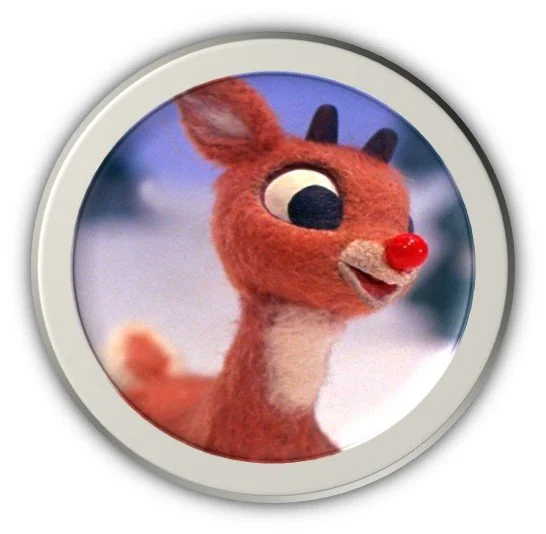
In 1964, the stop-motion television special gave Rudolph his now-familiar look and quietly secured his place in Christmas tradition, returning year after year to living rooms around the world.
Rudolph’s success brought May financial stability at last. He left Montgomery Ward to start his own business. For a time, he managed the income and licensing associated with our famous friend. Later, he chose to return to Montgomery Ward, not as a step backwards, but as another change of direction, bringing with him the experience of having seen an idea grow far beyond its original constraints. He remained there until retirement.
May’s path shows that change is rarely neat or linear. It happens through small revisions, careful choices, and the willingness to go back to the page rather than walk away. Rudolph’s creation is testament to that.
Many decades later, that small reindeer continues to delight and inspire. He reminds us that difference is not a flaw, that detours can lead somewhere meaningful, and that work created within the constraints of a role or brief can still end up lasting far longer than anyone expected.
And that is why a small reindeer with a red nose still lights the way every Christmas. I hope you look out for him this Christmas Eve. I know I will.
Happy Christmas all.